Showing posts with label Igor Andreev. Show all posts

Monday, May 25, 2009

It's Time To Get Down and Dirty

by Savannah

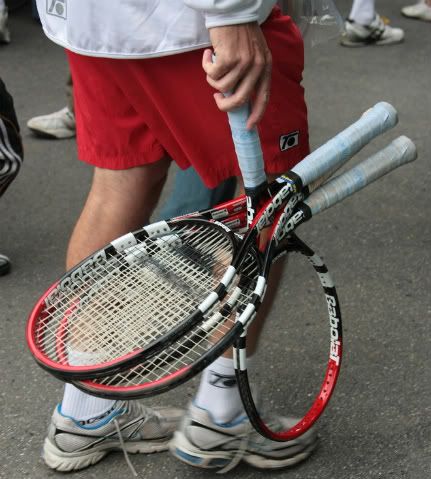
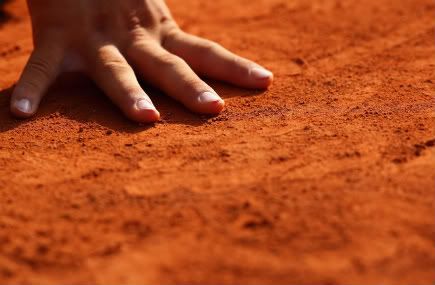
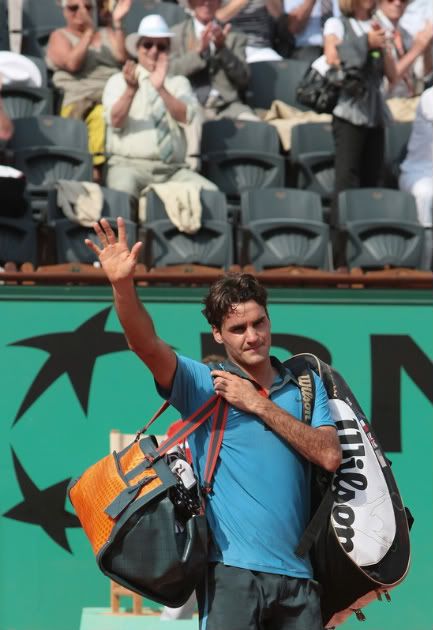
They come from all over. The elite and the wannabe's, the pretenders and the real deals. They have all converged on the City of Lights, Paris, France, to play in the tennis worlds second Grand Slam of the calendar year. They come like overgrown children to play the sport they love on the crushed brick surface known to all as the terre battue.

It doesn't matter if you are injured.

You come and get the red dirt in your hair, eyes and lungs. You slide around on it because you know the reward is tennis immortality.

You come to prove that there is still greatness in your body and mind.

You don't care that the world will see what you are deep down inside.

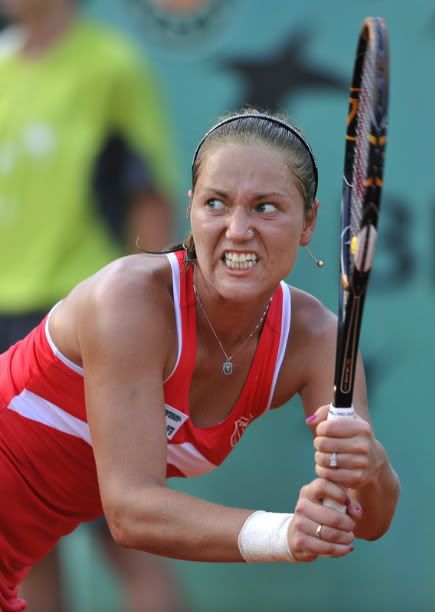
It doesn't matter if everyone sees you turn yourself inside out. You're here to win, and to do whatever it takes.

Does it matter if commentators call you out of your name? Nope. Your fans, and fans of the sport know exactly who you are.

Do you care whether people like the dress you've chosen for this momentous occasion?

Does the dress play or you?

What does it matter that you answer questions no one was asking?

You may know what they're asking and continue to do what you want because you can.

You may show unexpected grace under fire.

Or find yourself in a match that will ensure your name is mentioned in those "were you there when" conversations of the future.

So what if what your part in the magnum opus takes place miles away from home?

You've arrived and the world has taken notice of you and your talent even if some of the home folk don't appreciate it.

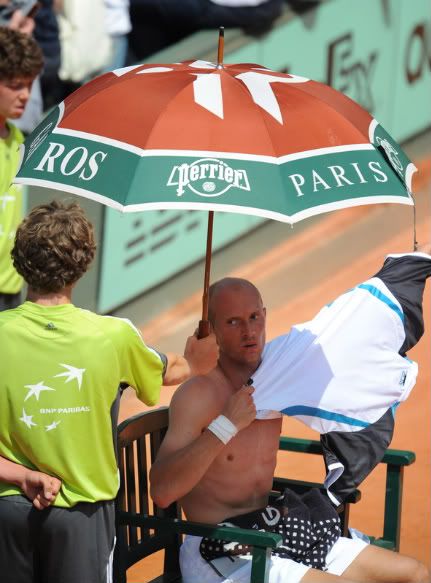
The sun has set on Day 2 of the French Open. It's been called the Artistic Slam. I call it the Heart, Mind and Guts Slam. You need all three to stand triumphant on it's dirt.

Monday, April 27, 2009

Heard Around

by Savannah

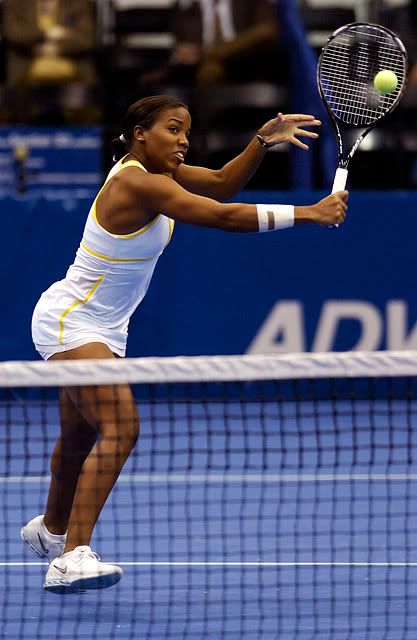
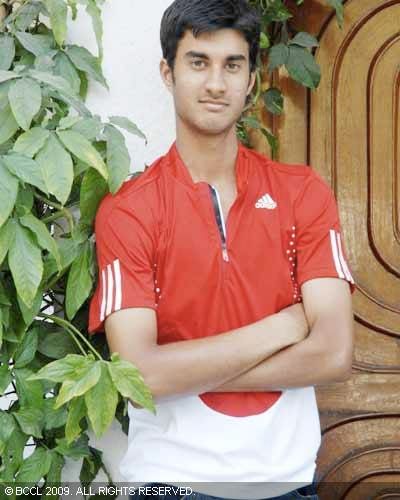
I came across some interesting interviews over the weekend. One is with Mashona Washington and is very entertaining. The others are with young Indian phenom Yuki Bhambri and pro veteran Igor Andreev.
I'll say upfront that Mashona was not asked about the recent vandalism issue but she does reveal a lot about herself, about the world of women's tennis, and how she sees herself.

Shelia: Hello Mashona, thank you for consenting to do this interview for Black Tennis Pro’s, I appreciate it.

Let’s start with some current issues in tennis, one of the most prominent being the recent resignation of WTA Tour CEO Larry Scott. Do you think that the WTA benefitted during his tenure?

Mashona: Yeah I think so, but it’s hard to speak specifics because I haven’t actually played full time on the tour since I was injured in ‘06, so I really haven’t been able to experience all of the pluses that he has brought to the tour.

After having been injured, you’re missing the tour meetings and while they send newsletters, I haven’t kept up as well as I should because I wasn’t playing that much, so it didn’t affect me. But he has had a lot of positive contributions, I’m sure.

Shelia: One of the things that Scott has talked about with reference to his decision making process to leave, was the rejection of his proposal to merge the two tours. Have you ever given any consideration to their being a single combined tour?

Mashona: I think that would be a great idea because I’ve found that when our tours in general are combined with the men’s events the quality of our tour - our tournament - is automatically raised because we just get a lot of the amenities men get. They get so much more in terms of ... sometimes I think if they came to one of our tournaments and had to deal with some of the things that we did, like with our - maybe amenities - or just some things that we get, they’d be like, oh my god!

You know, they’re really spoiled. We’re still spoiled, but I had two brothers that played on the men’s tour, so I could go with them and see all of the things that they are offered. Don’t get me wrong, we still have a lot of great things that are offered to us.

I think it’s a great idea, it makes tournaments more fun. You don’t have to see the same players all the time, or just women. I think it’s a great thing.
(...)
Shelia: Now, on another issue that has been making noise recently, the new drug testing rules which dictate that players must inform testers of their whereabouts for a period of one hour of everyday for a period of a week - how hard is that?

Mashona: Well, I haven’t really experienced that. When I was outside the top hundred I thought it was interesting that I was probably drug tested once, maybe twice; but as soon as I was in the top hundred, I was drug tested probably like eight or nine times in one year.

Shelia: Interesting....

Mashona: Now, it could be coincidental, yes. Or it could have just been, as they say ‘random.’
(...)
Shelia: When I read what some of the other players had to say about this new rule I felt for you all, I wouldn’t want to be so subjected.

Mashona: Sometimes it can be the last thing that you want to deal with. When I come off the road - my first three or four days - depending on how long I’m on the road, say six, seven, eight weeks, then the first two or three days - two days for sure - I’m like, in the bed. I don’t take any phone calls, I just want to be a vegetable. I want to just walk my dog in the park and that’s it. I don’t want to do anything.

Like I said, on the other hand, if that’s what it takes, I mean if you don’t have anything to hide, its just the way it is to catch the ones that are doing something.

The only unfortunate part is, you have like one person and it’s like the ‘lucky loser’ rule or the rule for the qualifiers. Because of a past issue, now it’s no longer the highest ranked player who gets in the draw. Now, there’s a draw and anybody who loses can get in.

Shelia: So, there’s no specific criteria within those who have lost during qualifying of who will become the a lucky loser?

Mashona: Okay, so you have qualifying, and you have four people that qualify, let’s say it’s a 64/32 player draw, you’re going to have four qualifiers - then each of the four players that lost in the final round of qualifying; then say there’s somebody in the main draw that withdraws, leaving a lucky loser spot, then one of those four can get in - a lucky loser.

So, in essence, it used to be where the highest ranked loser in the final round of qualifying would take that lucky loser spot, but because a couple of players on the men’s tour, they kind of did the math and they were saying ‘hey, I already know I’m going to get in and if you want to get in too, give me a little bit of your prize money and we can call it a day. I’ll throw the match so you can get in, I already know I’m going to get in....’ And so they would kind of cheat a little bit - get people in and get a little extra money.

So they changed the rule that if you lose in the final round of qualifying, then it’s pure luck of the draw. They take the four that lost and pull their names out of a hat. I don’t really think it’s that fair - you’re the highest ranked player, you should get in. They do that on the ITF and USTA events, they’re not doing that on the tour. Well, I think they did that at Wimbledon last year, maybe they’re using it at their discretion. I just don’t think that it’s very fair.

It happened to me when I thought I was going to get in because I was the highest ranked player, they were like, ‘the rule has changed, and I was like, what? I was crushed, I couldn’t believe it.

The entire interview is posted HERE.

In his interview Yuki Bhambri reveals the precociousness of youth alongside a mature vision of what he sees for himself as a pro. He has trained in the States and unfortunately has developed an aversion to clay.

Bhagya Ayyavoo: How does it feel to win your maiden ITF Futures title?

Yuki Bhambri: I couldn't have asked for a better start to 2009. First the Australian Open, came up with wildcard for Miami, probably the biggest ATP event after the Grand Slam. I played a close match against world No.70 (Diego Junqueira). And, then the tennis Futures win, to be the youngest Indian to do so. It's great.

BA: How has this transition been for you, from Juniors to the ATP circuit?

YB: I think I have been lucky to be training at the IMG. I have been lucky to play, you know there are lot of good players, lot of higher-ranked players. So, I have been in the atmosphere where I play sets on a regular basis with people ranked higher than me, who are playing in the Futures and Challenger level. I have been consistent and it gives a lot of confidence if you can come out and replicate the same thing in the tournaments. I mean, this is the first step towards the transition. I think it is a long long way and it is a hard grind and hopefully I can be there.

BA: It's been a couple of months since your junior Australian Open triumph. After that, you were looking forward to the Miami event where you got a wildcard. How did that tournament pan out?

YB: That match (against Diego Junqueira) gave me a lot of confidence because I was playing well, I was in that match. I thought I had a great chance of equalizing it or may be take it to the decider, and you never know what happens after that. If you can compete against a world No.70, how hard can it be to compete against a 400 or a 500 ranked player. It is just that extra motivation that was required for me..to believe in myself so that I can do it.

BA: You must have had a fair assessment of the ATP circuit by now. What do you think are the areas that you will have to work on to get better and be a consistent performer on the tour?

YB: Well, right now, I am focusing on playing more tournaments. The more I play, the more matches I get, the more confident I will be on court. The training has been good. I have trained for the last two months. The training aspect has been really really great. I have been focusing on developing my strengths - which is my forehand. The fitness part has been good. I haven't been really tiring on court. It's just a matter of playing more matches and winning them.

BA: How have you been preparing for the clay season?

YB: I wouldn't really be focusing much on clay. I am definitely focusing more on the men's circuit. Now that I know, I can beat good players and I can perform at that level.


BA: What's up for you next, what are the tournaments that you will be playing?

YB: I will be playing the ITF Futures next week as well in Delhi. There's a future next week. It is right here at DLTA (Delhi Lawn Tennis Association). And then I will be going to Kuwait in the middle of May. So, two more Futures.

BA: Are any of those two Futures clay events?

YB: No, not clay.

BA: You are the reigning Australian Open champion, so you can't go into the next Grand Slam - the French Open without any practice on clay. So how are you going to adapt to the new surface if you don't play events on clay?

YB: I will have a couple of days practice on clay.
I think the most important factor at the French Open me will be to get through the first couple of rounds. The earlier I adapt to the surface and how well I adapt to it. You know, like sliding on the court. That's really the main thing. So, the earlier I adapt to it, the better I will get, and I know that. So, it's about focusing and doing that extra bit of training on clay.

BA: So, does that mean no more junior events for you?

YB: I am not looking at playing the juniors any more. You play the juniors to win the Slam. So, there is really no point in playing there. But, I am actually looking forward to the Wimbledon (junior). It's the most prestigious tournament and I definitely want to get that one.


BA: Switching to the Davis Cup tie that was scheduled to be held in Chennai. You made it to the squad for the first time, but unfortunately the tie has been called off. Your thoughts on that?

YB: Well, it's unfortunate. But, it is a bonus for us as well. It would have obviously been a tough tie for us. I was looking forward to it, to be part of the team and watching Hewitt and Guccione play. But, on the other hand, we are in the World Group play-off. One more tie and we are in the World Group.


For the entire interview please go HERE

When I think of Igor Andreev I think seasoned pro. Well known to the serious tennis fan Igor has a dedicated fan base and when he is at his best he plays some of the best tennis around. Igor sat down with Mariya Konovalova of Talk About Tennis and talked about the sport of tennis on the main men's tour.

Currently ranked No. 22 in the world, the Russian sat down with TAT after advancing to the quarterfinals of the Grand Prix Hassan II ATP World Tour tournament in Casablanca, where he was the top seed.

TAT: Igor, can you clarify your coaching situation? You’ve been alone for over a year now. Are you looking?
IA: I’m alone for now. It’s possible that for the period up to Roland Garros someone will be traveling with me, either a physio or someone from Valencia. But so far, I’m OK alone. So, really, I’m not “on a hunt,” such that I must find someone.

Of course, there are moments when you need training, help getting into playing shape, but overall, I’m still pretty satisfied as is.

TAT: And when you’re training in Valencia are you alone there also, or you have someone there?
IA: Well, in Valencia, it’s an academy. I’ve been there a long time, and there are coaches there, guys you can practice with. Same in Moscow. So, things like practices and such, there are no problems with that.
(...)
TAT: You did not play in South America this year, whereas you have in the last couple of years. Why did you decide on that?

IA: There are many reasons. First of all, there are technical things like getting visas, and of course, all the traveling, it takes a lot of time. Possibly, next year I will play there, I don’t know. Actually, the tournaments there are really good.

TAT: Can we talk about the transition to the clay season? How long does this process usually take for you? You’ve had difficulties with the first two matches here, is that related to the surface switch?

IA: Well, of course, the surface transition is difficult. Actually, switching to clay is probably even a little more difficult, because it’s a demanding surface. You have to move a lot and really well, and in the beginning, you end up stumbling trying to get the positioning right. Of course, you need time to adjust, and, ideally, time off to train. But, with the schedule we have, I decided to play here; I didn’t have time to train. As I got here, I had to play right away, so it was a little difficult. But, the most important thing is winning, and I can still see some progress.

TAT: Clay is the surface where you’ve had the most success. Do you feel more comfortable on it?

IA: Well, really, these days, I would not say clay is my best surface. I’ve had some good results on hard for awhile. Really, with time, as you play on tour for several years, you get used to all kinds of courts.

TAT: You’ve been ranked around the Top-20 for the last year or so. Do you have any sort of goal for this year?

IA: Well, the goal is just to improve my game. You can’t just look at rankings. It starts with the right shot, and then you’ve won the point, then the game, the match, and so on. Of course, it would be good to get the ranking higher, but you can’t just think about that. What you should be thinking about are just things that will help you hit the ball right, and the rest may come from that.


End Notes

Dinara Safina begins play as the number one woman in the world at Stuttgart this week.

James Blake has already crashed out of Rome losing to Victor Crivoi 7-5 and 6-3. At one point Blake was down 0-5 in the first set. Some fans said Blake looked totally unfazed by his poor play at the beginning of the match but he did recover and make it decent.

Novak Djokovic has hired a new fitness coach. Gebhard Phil-Gritsch of Austria worked famously with Thomas Muster. Speaking of Mr. Djokovic I wonder what he was thinking when he performed this little dance during an exhibition in memory of Federico Luzzi prior to the start of the Rome M1000?


David Nalbandian may have to have surgery on his right hip. The injury forced him out of Barcelona.

Tuesday, March 17, 2009

Be Careful What You Ask For

by Savannah

I apologize to all of you. I've been bitching and moaning about the almost total blackout of women's tennis these last few days/weeks and I was glad that finally tennis was going to be shown not only on TennisTV but on broadcast television as well. So who were we going to see? The woman who knocked Elena Demetieva out of the tournament, Petra Cetkovska of the Czech Republic against the veteran player Daniela Hantuchova. Somewhere the tennis gods are laughing in their green beer. Ms Cetkovska is an attractive young woman and many male tennis fans loved watching her. Unfortunately Ms Hantuchova, another attractive woman, was on the other side of the net.

I have seen Daniela play before. I've seen her play relatively quickly. Last night I wanted to stick pins in my eyes. I have to say I am rarely bored by a tennis match. If I'm not interested in who is playing I can find other things to occupy my mind until a better match comes on. Unfortunately last night there was no other game in town. If it wasn't for the music of the Buena Vista Social Club and an unintentionally funny video from "Phantom of the Opera" I would've been in lala land and totally missed the men's match that came afterwards.
More on that later. I sincerely hope that match was not some poor unfortunates introduction to women's tennis. The match should've taken less than an hour. Instead it ending up lasting about two hours. Now when I mention the worst tennis match ever I have to use the plural. The first was the moonball match between Conchita Martinez and Amanda Coetzer. This match last night is number two on my list. Simply horrid. I would like to see Cetkovska play again as long as it's not against Hantuchova.

Let me say now that the WTA coverage from Miami will be the same as it was at Indian Wells. The sisters Williams will be playing. And you will not hear one peep from me about the unfairness of it all.

It was hard to regain my focus when the women's match was finally over. I have rarely seen an entire match of Igor Andreev's and I was looking forward to it. He was playing Jo-Wilfried Tsonga who as we all know brings the fire when he's on court.

Like all Frenchmen he plays with both skill and flair. He is in constant motion and a fan favorite. There are times though when the flair gets in the way of the skill and last night was one of those nights.

Jo was trying to get points over quickly. Igor wasn't. It was obvious before the end of the first set that Jo was not going to beat Andreev. Because of the length of the women's match there weren't many fans left - it was a work night - and maybe that's what Jo missed. I don't want to make excuses. Igor totally outplayed Jo last night. Tsonga's camp was glum from the beginning of the match. Was there a problem with his back? At any rate Andreev, with an upset win, moves on and will play Ivan Ljubicic who has to be happy about his win over Gilles Simon.

Fernando Gonzalez of Chile totally destroyed James Blake. Fernando never allowed Blake into the match playing the best tennis I've seen from him in awhile. He's gone back to his hard hitting but incorporated what he learned from Larry Stefanki. The commentators were talking up a grudge match between the two after what happened in the Olympics but if anyone proved anything yesterday it was Gonzalez. Blake, out of the top ten for the first time in a long time, has to be wondering if that's all there is.

Meanwhile the other Fernando, surnamed Verdasco, from Spain, made mincemeat out of France's Richard Gasquet. Gasquet seemed to be out there as the foil for a newly energized and confident Verdasco who proved his showing in Melbourne was no fluke. At times Gasquet looked as if he was wondering where he was as Verdasco chewed him up and spit him out.

It was not a good day for French tennis.

Meanwhile these two men played doubles and seem to have quietly settled a feud that had tennisheads enthralled. If you don't frequent fan boards (or are a newcomer to this blog) you may not know about the telenovella that had dominated Argentine tennis for the last few months. Let's just say David Nalbandian and Juan Martin del Potro weren't playing golf together. On the way to California it just so happened both men and their entourages were on the same flight and it was decided that it was time to bury the hatchet and reconcile the warring factions. I'm sure the Argentine press ate this up. I wish we could've seen some of the play here. The only doubles news that was deemed worthy of coverage in the States was the meeting between Bob and Mike Bryan and what would've been the Swiss doubles team of Yves Allegro and Roger Federer. Do I have to tell you the results? I didn't think so. The Bryans moved on in the draw.
By the way Nalbandian and Del Potro knocked out the number four seeds Lukas Dlouhy and Leander Paes 7-6(6) and 7-6(5). They will face the team of Andy Roddick and Mardy Fish next.

Monday, September 24, 2007

Davis Cup - Russia vs Germany

by mmmm8

It did not start well.

First came the bad news for Germany. Michael Kohlman, half of Germany’s strong doubles duo (with Alexander Waske), was out of the tie with a knee injury for which he will need surgery. In a surprise decision, German Captain Patrik Kühnen nominated a newcomer,
Philipp Petzschner, as the fourth player, skipping numerous higher-ranked, more experienced Germans, most notably Florian Mayer (who came to the tie but did not play) and Nicolas Kiefer.

Then came a double whammy for Russia. In a prelude, we found out that Mikhail Youzhny, a key singles player, got a bad cold at the US Open and was still recovering. Then we learned, along with the rest of the world, that Marat Safin had an old, and serious wrist injury flare up in his US Open match against Stanislas Wawrinka and was out of commission. But wait! Marat was also taking his bad wrist to the Himalayas for a month to climb the sixth tallest mountain on the planet. Even though Marat ended up satisfied with just a 5000-meter climb and a week at high altitude, the Russian team was left without its leader and most experienced player for the tie.

Then there was the surface. The clay court was speedily laid right on the volleyball court used for the European Championship on the Sunday before the tie. Clips of practice showed
Dmitry Tursunov, a man who will never be called “King of Clay,” throwing racquets so hard out of frustration with the surface he actually broke a plastic bleacher chair.
Tommy Haas, the top German player, was vocal about his lack of fondness for the surface as well. No bleachers were harmed, but Haas looked like someone had just hit him with a frying pan in every photo from Moscow.
To add more intrigue, on Wednesday before the tie, Russia’s Number 1 Nikolay Davydenko also had an old wrist injury return during practice and became questionable for the tie.

DAY 1


Igor Andreev d. Tommy Haas
6-2 6-2 6-2

The match between Russia’s best clay courter and Germany’s best player sounded promising but Tommy forgot to show up. Andreev should be credited for playing a great match. After a nervous first 2 games, he never trembled again. Focused and calm, he played precise shots, missing nothing, running down impossible balls, and, of course, ripping his forehand. The only thing working well for Haas was the drop shot, but he only sent Andreev a few of those, and failed to draw Igor to the net otherwise.

Tommy may not have been ready for the surface, or for Andreev’s stellar forehand (they had never played before), but he showed a lack of desire and fight in this match, a surprising and disappointing performance for the team leader and a top player.

“We knew Tommy didn’t like clay, but we didn’t realize just how much,” joked Mikhail Youzhny’s coach Boris Sobkin.

So, after a surprisingly easy rubber, Russia led 1-0 and all signs pointed to an easy victory for the Russian team, with World No. 4 Nikolay Davydenko taking on 32nd-ranked Philipp Kohlschreiber.

Philipp Kohlschreiber d. Nikolay Davydenko
6-7(5) 6-2 6-2 4-6 7-5


When Nikolay arrived on court, it was obvious that he was not in top shape. However, he had a solid start, and one would not have guessed just how unready he was. Unknown to fans in addition to having freeze therapy to alleviate his wrist pain prior to the match, Nikolay was also coming off food poisoning the previous evening, and had a fever from a cold. Later, we also learned that a tactical decision hurt his chances in the match. Although the doctors cleared him to play through the wrist pain (the injury could not be aggravated), it was decided to give him lighter tension on his strings in order to prevent pain. He did not have sufficient time to practice with the racquet, felt uncomfortable with it, and, after three sets, could not bear it anymore. He went back to his usual tension, despite incurring more pain in an already injured wrist.

In addition to own issues, Davydenko ran into an in-form and extremely determined Kohlschreiber. Philipp was everything Haas wasn’t in the first match. He fought through every point, he played attacking tennis, he did not give away free points. After the match, Philipp said it was one of the best matches he has ever played.

Davydenko was able to fight him off, however, and was leading 4-2 in the fifth set, two games away from giving Russia a 2-0 lead. And then he got broken. And, a little bit later, he was broken again, losing the deciding set 7-5. The cold and fever, the pain, the general nervousness of playing with an injury, Kohlschreiber’s fight and excellent play, it all counts in explaining why Davydenko failed to close out the match. But, in the end, what happened was that Nikolay lost yet another DC match, and a crucial point for Russia with it.

A somewhat expected result, 1-1 at the end of the first day, but a surprising way to get to that score.

DAY 2:

P.PETZSCHNER / A.WASKE (GER) def. D.TURSUNOV / M.YOUZHNY (RUS)
6-3 3-6 7-6(4) 7-6(5)

It wasn’t even as close as the score seems to indicate.

Dmitry Tursunov and Mikhail Youzhny came out on court absolutely flat. Youzhny stayed that way the whole match.

Part of the problem was the lack of experience from Tursunov and Youzhny as a doubles partnership. They lacked communication, they did not have a feel for each other’s tactics; they did not have a game plan.

Part of the problem was the formation. Perhaps having Youzhny take returns on the left side would have made the match more comfortable for his game style.

Another problem was that neither Youzhny nor Tursunov had played much recently. They were both rusty. Youzhny failed at structuring the points (among other things), and Tursunov attempted to make every service return a winner, but he had no feel for the doubles court.

Another thing the Russian pair did was underestimate Petzschner. The Russians admitted to not having expected the German’s booming serve, or his apparent lack of nerves in Davis Cup debut.
But whatever its parts were, the whole problem came down to the Russian’s unpreparedness and lack of fight in the match.

Consider the Germans’ situation. Without a doubles team, Patrik Kuhnen took a risk by putting in an inexperienced player, whose one experience playing with Waske came five years ago (although Petzchner was coming in off a challenger-level doubles win the prior week). The rookie justified the Captains choice, but his other, “sure bet” doubles player’s serve goes away in the second set, and the score is at one-set all.
Then, in the middle of the third set, Alexander Waske feels something pop in his arm. It has been bothering him since Roland Garros, but this time, the pain is almost unbearable. He walks to the bench and sits down (no one knows what is going on at this point). He contemplates quitting the match. Finally, the medics put something on his arm to alleviate the pain, and he plays through it. But he is serving “little girls’ serves” (his personal description), mostly under 100 miles an hour.

The Germans were lucky that Youzhny and Tursunov completely failed to attack Waske’s serves, but Philipp Petzschner was the best player on court that day. He consistently served over 130 miles per hour, he showed a great feel for the court, especially at net, and he was not at all intimidated by the occasion. It was apt that the last point of the match was a winner from him.

With a loss of a very winnable match, trailing 1-2, an injured and sick Number 1, and an out-of-form Number 2 player, things seemed very bleak for the defending champions going into Day 3.

DAY 3

M.YOUZHNY (RUS) def. P.PETZSCHNER (GER)
6-4 6-4 3-6 6-3

Those of us who woke up at 5 am Eastern USA time to watch the third singles rubber must have thought the weekend’s sleep schedule has caught up with our sanity. It was not a big surprise to see Mikhail Youzhny playing for Russia, given Davydenko’s physical condition, but it was a shock not to see Tommy Haas. Later, the commentators revealed Tommy was suffering from food poisoning (WHAT do they put in that cafeteria food at Davis Cup ties?), and was unfit to play.

A break for Russia, although Youzhny would have had a great chance against Haas on Tommy’s least favorite surface. Luckily, Youzhny came ready to play unlike he had the day before. Mikhail did not play spectacular tennis. Compared to his best, he played rather poorly. But this time, Petzschner did show why he is ranked about 200 spots lower than Youzhny. He continued to serve big, stayed calm, and never gave up, fighting to win the third set. But, even then, the outcome was obvious. He was simply outclassed by Youzhny, who did what he had to – no more, no less.
Youzhny was not the only person to redeem himself after Saturday’s disastrous doubles. Dmitry Tursunov, once again, proved why his creativity is more famous than his tennis skills. He used metal cooking ware from the stadium’s kitchen as noisemakers, starting out with a ladle and mixing bowl, then sent a practice partner to the kitchen to equip the whole team with pots and ladles. It was loud, fun, and very festive. Dmitry gets the creativity award here (not that he needs another one).

I.ANDREEV (RUS) def. P.KOHLSCHREIBER (GER)
6-3 3-6 6-0 6-3


Even if the same Philipp Kohlschreiber who had played a stellar match against Davydenko on Friday had shown up here (he did not), even if the German did not trail 0-4 in their head-to-head (he did), Igor Andreev would have won the tie for Russia. As soon as he stepped on court, it was obvious he was determined to not let the tie slip away.

Aside from the distraction – caused by the appearance in the stands of Marat Safin, who came to support the team, but left when people started watching him rather than the match – that caused him the second set, Igor played another concentrated, clean, aggressive match.

Kohlschreiber was less confident and seemed somewhat overwhelmed by the crowd as well as by Andreev’s power. He still tried everything in his arsenal, but things were just not going his way. He had a brief resurgence after getting bageled in the third set, but Igor shut the door once and for all in the fourth set.

As calmly as he played his matches, Andreev, who missed most of last year, including three of the Davis Cup ties due to an elbow injury, walked to hug Shamil Tarpishev and shake hands with the disappointed German team.

Russia had won its 7th straight Davis Cup tie and was in the final again.

A few conclusions from this DC Semifinal:

- An embarrassing and unlucky tie for Tommy Haas

- Lots of respect for Nikolay Davydenko, who played an extremely competitive match against a very in-form Philipp Kohlschreiber through pain, fever, stomach issues, and a foreign racquet tension. Now, if he could only learn to close out matches in Davis Cup.

- Even more respect to Alexander Waske. His pain was so bad he wanted to stop play. Now, his arm is swollen and he cannot even brush his teeth with it. He is expected to be off the tour for two months. But he played out his match, and with the help of his partner and the Russians, gave Germany a great chance.

- Philipp Petzschner rose to the occasion. The strongest player in the doubles tie, he was outclassed by Mikhail Youzhny in singles, but showed great fight. Kudos to Patrik Kühnen for the pick - he sure has some "wilanders".

- Whether the clay surface was chosen for Marat Safin (according to Davydenko and somewhat confirmed by Tarpishev), or against Haas, it was a great choice for Russia, because it most suited the best player of the tie, Igor Andreev.

- It is not wise to jack up prices for Davis Cup ties to unreal heights. Converting most of the 20,000-seat stadium into “luxury” seating, and then selling tickets at over $200 resulted in an embarrassingly empty stadium Friday and Saturday (3000-4000, but felt like 300-400). That said, there were tickets available for $10-30, and lots of those did not sell until Sunday’s matches either.

- Ironically, Andreev, Russia’s Davis Cup hero this year, is the player least likely to play in the final against the US since his game does not match up against USA’s singles players, and other team members perform better on fast surfaces.

- Someone needs to tell Dmitry Tursunov that throwing steel ladles into the stands is not safe.

- Two of my favorite umpires, Pascal Maria and Mohamed Lahyani, officiated the tie. Before Saturday’s doubles match started, music was playing in the stadium. Pascal Maria and an unidentified woman were dancing courtside. Can anyone imagine this from an official in another sport?
- Shamil Tarpishev is still my hero.